
AI has already changed how people search for and plan travel. The next shift is bigger: moving from AI as a research assistant to AI as an agent that can actually facilitate a booking.
To understand consumer sentiment around agentic AI for travel, Dune7 partnered with boutique market research firm Flesh & Bone on a new, comprehensive study of 1,000 U.S. travelers. The topline takeaway is clear:
Travelers are open to agentic travel booking in principle. But trust, control, and accountability will determine how quickly adoption actually happens.
Interest is real — but it is not evenly distributed
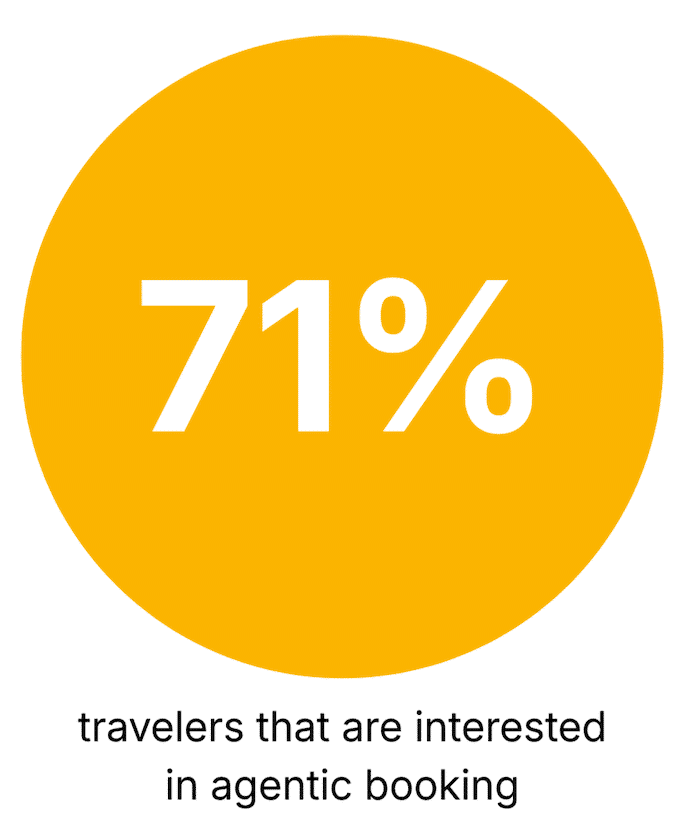
At a topline level, 71% of travelers said they are very or somewhat interested in agentic travel booking. That is a strong signal that the technology has moved beyond novelty.
But adoption will not happen evenly across the market.
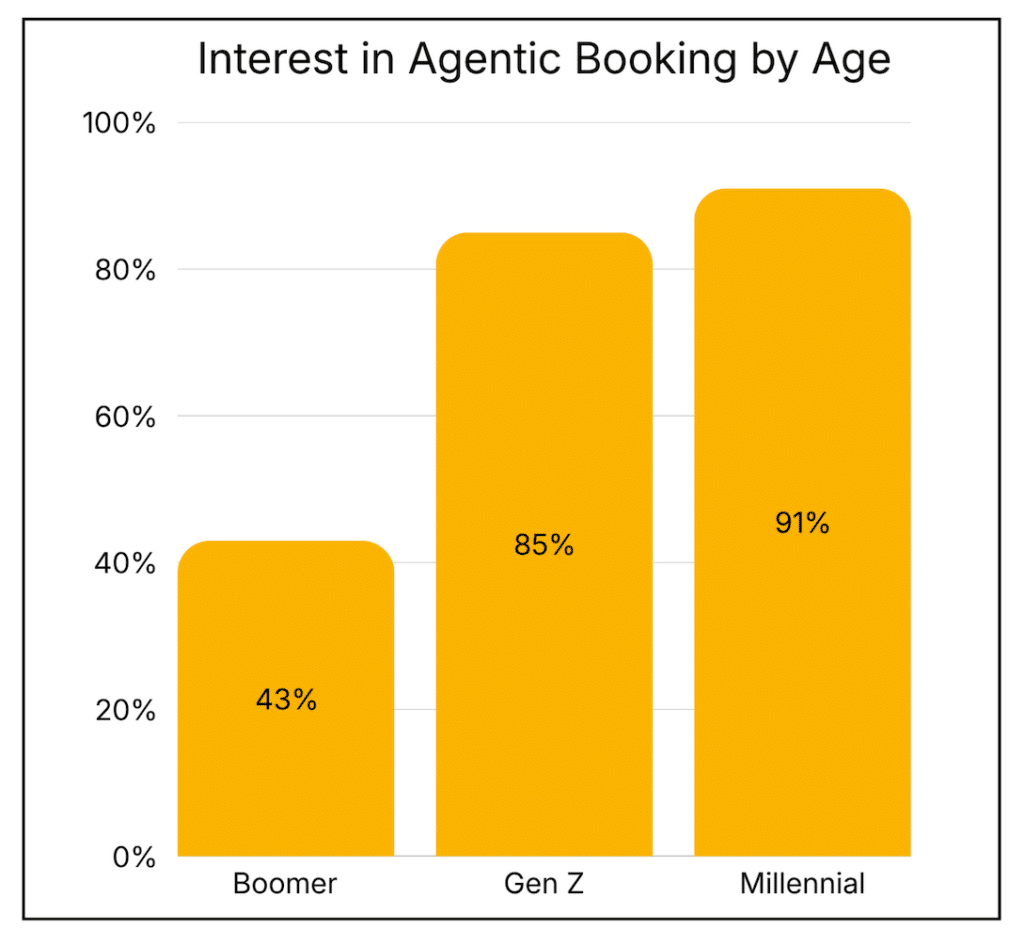
Not surprisingly, younger travelers are more receptive overall. Interest is especially high among Millennials (91%) and Gen Z (85%), while it drops off sharply among Boomers+ (43%). Business and international travelers also stand out as high-potential segments, suggesting that travelers who are generally more tech savvy and value convenience will lean into agentic booking going forward.
Current AI users are further along the curve as well.
Travelers who already use tools like ChatGPT, Gemini, or Claude for trip planning are much more likely to see agentic booking as the logical next step.
That said, openness does not mean blind trust. Across nearly every segment, travelers want some level of oversight before letting AI transact on their behalf.
Travelers want AI to help most where travel is inefficient
When asked where they would be most likely to use agentic booking, travelers skew toward commonly transacted travel products:
- Booking hotels: 66%
- Booking flights: 65%
- Building & booking personalized packages: 61%
- Booking activities: 61%
Appetite is lower, though still meaningful, for higher-stakes scenarios like purchasing travel insurance (51%) and canceling or rebooking travel (49%).
The strongest benefits are speed, savings, and adaptability
When travelers think about the upside of agentic booking, the appeal is not abstract. It is highly practical.
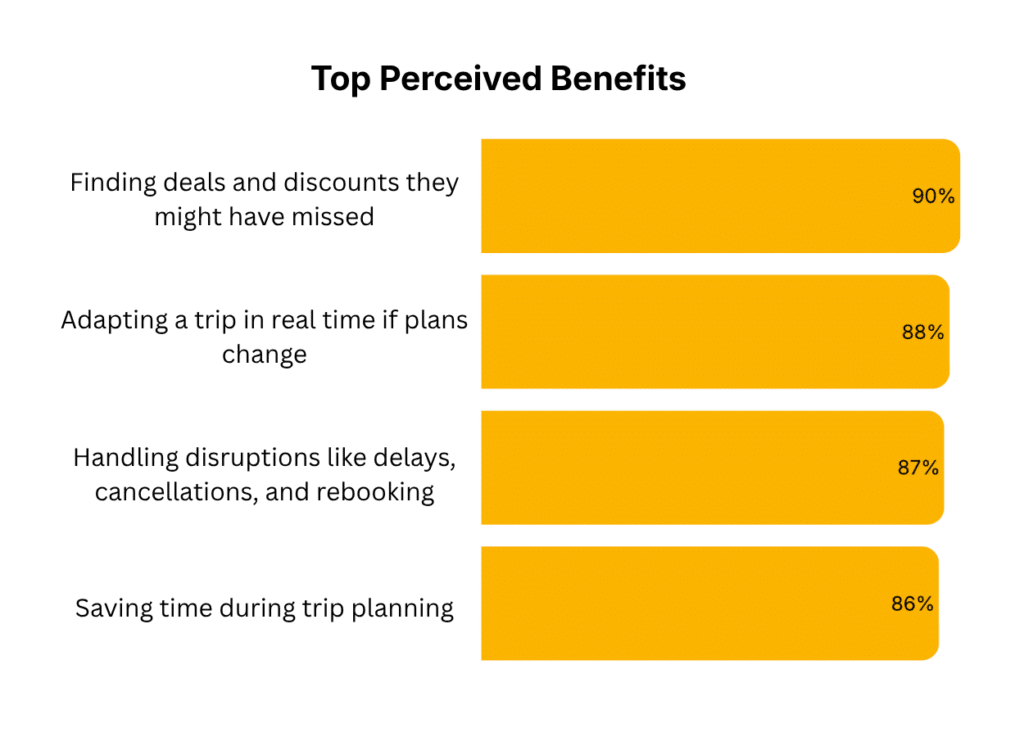
The biggest perceived benefits are:
- Finding deals and discounts they might have missed: 90%
- Adapting a trip in real time if plans change: 88%
- Handling disruptions like delays, cancellations, and rebooking: 87%
- Saving time during trip planning: 86%
There is also evidence that personalization has real potential, especially among younger travelers, business travelers, and loyalty members. Features like honoring loyalty preferences, using points automatically, and requesting upgrades are all seen as benefits of agentic AI.
For hotel loyalty members in particular, these features appear to help signal that the AI is working in the traveler’s best interest.
Trust is the make-or-break issue
If the benefits are clear, the barriers are as well.
The leading perceived risks focus on what happens when something goes wrong:
- AI errors being harder to reverse than human errors: 80%
- No human to advocate for the traveler: 80%
- Personal data being used for other reasons than booking the trip: 79%
- Not knowing who is responsible if something goes wrong: 78%
- Difficulty resolving issues with airlines or hotels: 78%
This is the central tension in the data.
Travelers are open to delegation, but they do not want ambiguity around accountability.
Women and older travelers, in particular, are more likely to express concerns around responsibility, advocacy, privacy, and error handling. Boomers are not simply less interested in Agentic travel booking overall; they are, by far, the most likely to question who would fix the problem if the AI agent made the wrong call.
The ‘fun’ factor
Notably, the often-cited concern that AI could “remove the fun” from travel planning does emerge, but is less salient than operational risks like mistakes, privacy, and dispute resolution. Many respondents agree with that statement in principle, yet a much smaller share (23%) say “losing enjoyment or sense of accomplishment” is a big personal risk when using agentic AI for booking.
As such, this is more of an “ambient concern” than a core adoption barrier. Travelers say it because it feels true, but when all factors are taken into account, serious risks, responsibility, reversibility, privacy, human advocacy, and error-handling are more likely to be seen as personal risks of using the technology.
What unlocks adoption
The most powerful adoption drivers are all forms of control and recourse:
- Guarantees or protection against booking errors: 86%
- The ability to approve before payment is finalized: 86%
- Human support if something goes wrong: 86%
- The ability to take over the booking at any time: 85%
- A clear refund or dispute resolution process: 84%
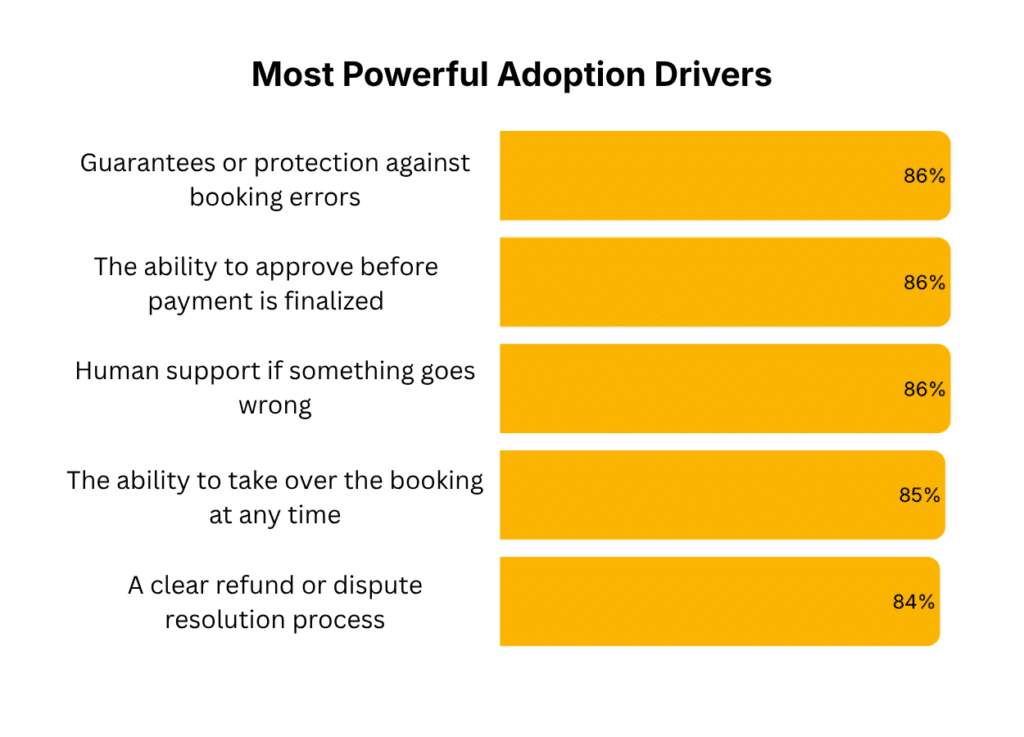
This is the clearest takeaway for travel brands and travel tech companies. Consumers are not asking for fully autonomous, agentic booking. They are asking for delegated convenience with visible guardrails.
That is a very different product brief than simply embedding generative AI into search or trip planning.
Specific traveler personas and their views on agentic AI
Business vs. leisure travelers
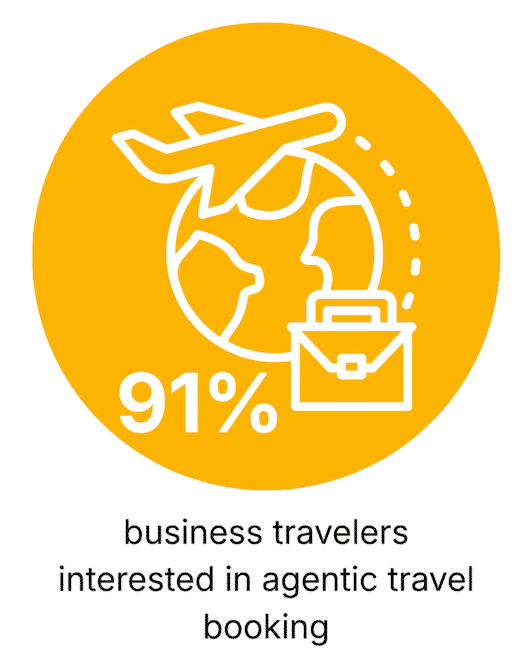
Business travelers are the most receptive segment in the study, and like others, they are looking for automation but only with oversight. 91% of business travelers express interest in agentic travel booking, compared with 57% of non-business travelers.
They are also more likely to say features like providing the AI assistant with a list of airlines or hotel brands I frequently use, ability to see the decision making process of an AI assistant, and the ability to set a maximum dollar amount for the agent to spend would increase their likelihood to use it. That suggests business travelers see agentic AI less as a novelty and more as a high-utility tool for reducing friction — but only if the guardrails are present.
International vs. non-international travelers
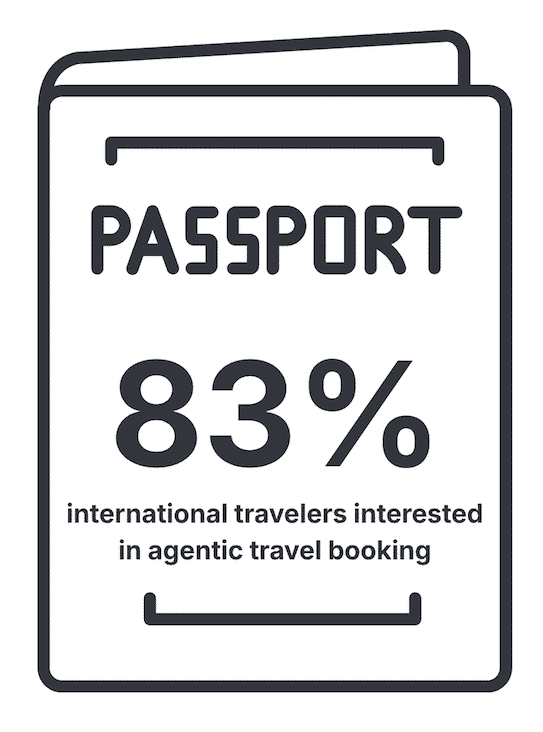
International travelers also stand out as early adopters in the study. 83% of international travelers said they are very or somewhat interested in agentic travel booking, versus 58% of travelers who did not take an international trip in the past 12 months.
They were also more likely to say they would use agentic AI for more complex tasks like purchasing travel insurance (64% vs. 35%) and canceling or rebooking travel (60% vs. 36%). The pattern is straightforward: the more moving parts a trip involves, the more attractive AI-powered delegation becomes — as long as travelers still feel they have control.
Loyalty program members
Loyalty members appear especially responsive to the idea of agentic AI when it can act in line with their existing preferences. Hotel loyalty members, in particular, are more likely to see value in features like honoring preferred brands (89% vs. 78% non-members), using loyalty points (87% vs. 80% non-members), and helping secure upgrades (87% vs. 76% non-members).
That reinforces a broader theme in the research: for loyalty-oriented travelers, trust depends not just on personalization, but on confidence that the agent will get the booking right.
The outliers — why some travelers are not interested in agentic booking
While the large majority of travelers expressed interest in using agentic booking, nearly 30% of respondents said they were either unsure or not interested in harnessing the technology.
Among this cohort:
- 42% prefer booking and planning themselves and want control over choices
- Interestingly, 67% of Gen Z travelers in this group responded this way vs. only 44% of Boomers
- Only 14% said it’s because they prefer using a human travel agent
- Less than 2% said it’s because they are concerned over the carbon footprint necessary to power agentic travel bookings
The takeaway for travel brands
Agentic travel booking has real market potential. But the winners will not be the brands that push hardest on automation alone. They will be the ones that combine automation with transparency, control, and some level of human support.
Consumers are already telling us what they want: help me save time, find better options, and manage complexity — but let me set the rules, approve the spend, and know who has my back if something breaks.
This is the roadmap for making agentic AI truly relevant for the global travel industry.
Methodology
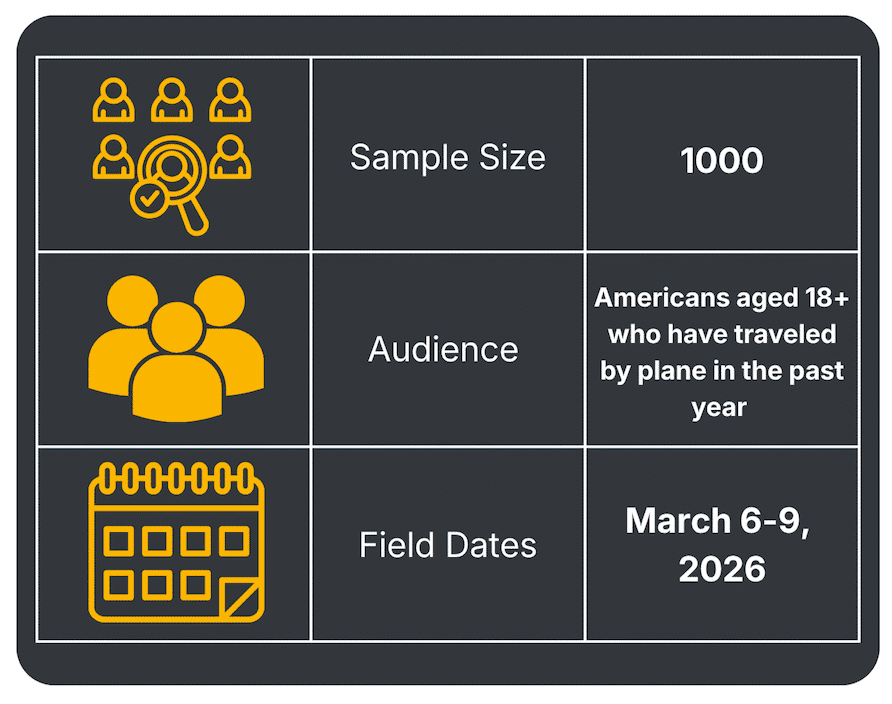
An online study was conducted among a nationally representative sample of 1,000 Americans aged 18+ who have traveled by plane either domestically or internationally in the past 12 months. Fieldwork was conducted March 6–9, 2026. The results have a margin of error of approximately ±3.1 percentage points at the 95% confidence level.
For the study, agentic travel booking was defined as using an AI travel assistant that does not just make suggestions, but actually searches, compares, selects, and books a trip based on a traveler’s preferences and rules, with the option to review or adjust before purchase.




No comments.