

AI search is moving from a black box to something marketers can actually manage.
One of the challenges with the shift towards AI-powered search has been a lack of visibility and control.
For travel brands, AI is now firmly part of how customers plan and research their trips. Phocuswright found that 56% of active U.S. travelers used AI for planning, booking or in-destination assistance for at least one trip in the past year, up from 33% in the first half of 2025.
That makes visibility within AI-powered discovery increasingly important.
But for marketers, understanding when and where a brand appears has been difficult. At the same time, decisions around AI crawlers have often been binary: allow access or block it, without much control over whether content is being accessed for search discovery or other uses such as AI training.
Two recent updates from Google and Cloudflare suggest that this is beginning to change.
Google is giving site owners more insight into their visibility within generative search, as well as greater control over whether their content is displayed in those experiences. Cloudflare, meanwhile, is introducing more granular controls over how different types of crawlers can access a website.
For brands, and particularly for those of us working across SEO and GEO, this matters. Organic visibility increasingly spans traditional search results, AI Overviews, AI Mode and other AI-powered discovery surfaces. The technical decisions that determine whether machines can access a site are now table stakes for any proactive search strategy.
Google is finally giving us clearer visibility into AI search performance
Google's new Generative AI Performance report in Search Console is now available globally, giving marketers a dedicated view of how their websites appear within AI Overviews and AI Mode. Google has introduced a separate report for generative AI experiences.
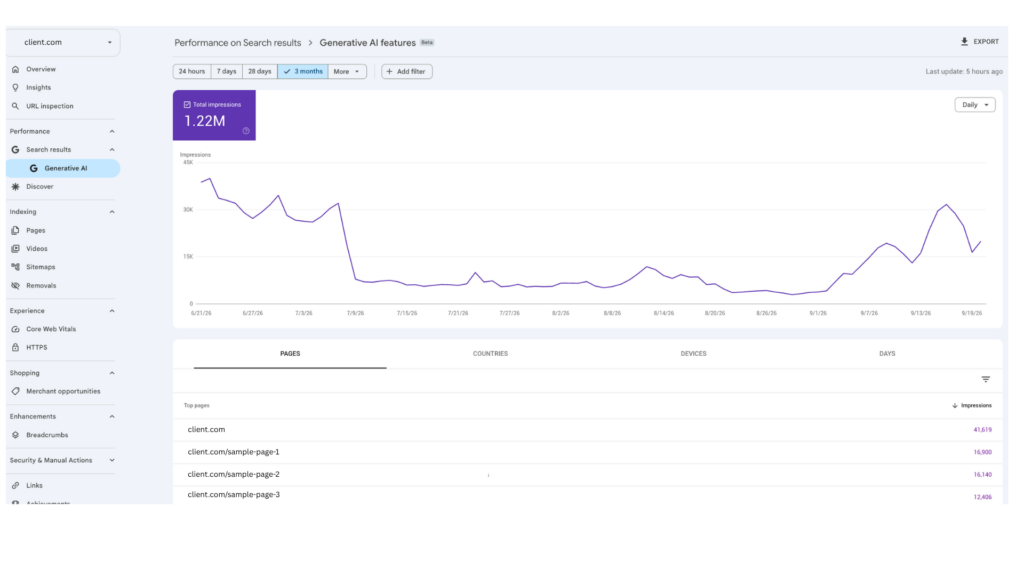
Sample Generative AI Performance report in Search Console
The report focuses on impressions, which is a good proxy for overall brand visibility. We can see which pages are appearing most frequently and break that visibility down by country, device, and date. What we don't get is the same depth of performance data available in traditional Search Console reporting, such as queries and clicks.
So, this isn't a complete answer to AI search attribution. But it is another useful signal.
At Dune7, we use Search Console alongside LLM-specific measurement tools to better triangulate visibility for our clients. Traditional rankings, clicks, and conversions still matter, but now we can answer another question: which parts of a client's site are actually surfacing in Google's generative experiences?
That feeds directly into content audits and strategy. Where we see content performing strongly in traditional search but lacking generative AI visibility, we’re able to provide suggestions on ways to fill the gaps and optimize towards increased mentions and citations in LLMs.
Google is also giving publishers a choice about participating in generative search
Measurement isn't the only change. Google has also rolled out a Search Console control that lets site owners exclude their content from AI Overviews, AI Mode, and generative AI features in Discover. Google says using the control does not affect inclusion or rankings elsewhere in traditional Search.
Importantly, this is separate from allowing bots to access a site’s content for AI training.
Google's new Search generative AI control determines whether content can appear and help ground responses within its generative Search features. Google-Extended separately lets publishers limit the use of their content for training models used to generate those responses.
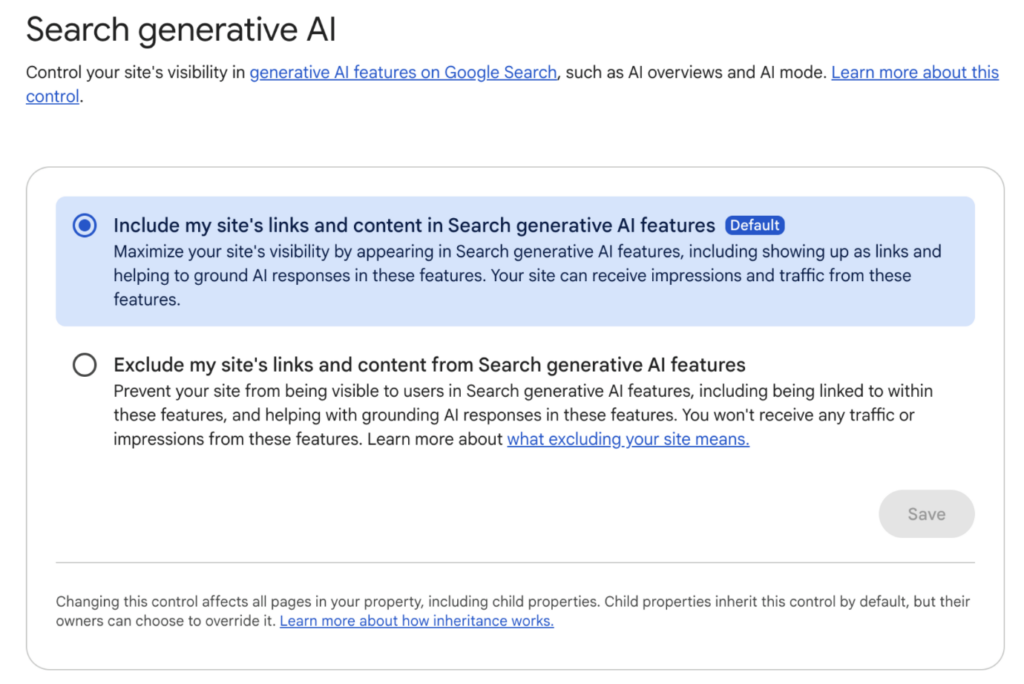
GSC > Settings > Search Generative AI Setting Feature
For the large majority of travel brands we work with, we suggest allowing Googlebot to crawl a site for the purpose of participating in generative search results. There are exceptions. A media company that relies heavily on subscriptions or otherwise keeps content behind a paywall, for example, may have a very different calculation.
The important change is that publishers now have a clearer choice and an easy way to opt in or out.
Cloudflare is separating search crawling from AI training
Cloudflare sits between a website and the visitors or crawlers trying to access it, helping manage traffic, performance and security before requests reach the site's server. This also puts Cloudflare in a position to identify and control which crawlers can access a site and how.
Its latest update gives publishers more control over that access. The new ‘Disallow AI Training’ setting allows participating crawlers to continue accessing a site for search while signaling that its content should not be used for AI training.
This distinction matters for SEO. Cloudflare's ‘Block’ option can also restrict mixed-use crawlers such as Googlebot, Bingbot and Applebot, potentially affecting search visibility. For brands that want to remain discoverable without opening their content to AI training, crawler settings now offer a more deliberate approach.
More broadly, Cloudflare is moving toward separate controls for ‘Search, Training and Agent’ activity, making it easier for publishers to decide how they want to participate in each.
What these updates tell us about the direction of SEO and GEO
Cloudflare's changes matter at scale. According to Netcraft's May 2026 Web Server Survey, Cloudflare serves nearly 22% of active websites and more than 27% of the world's one million busiest sites. That means changes to how Cloudflare handles search and AI crawlers have the potential to affect a significant portion of the web.
Taken together, the Google and Cloudflare updates point toward three decisions becoming increasingly distinct:
Search discovery → AI search visibility → AI training
A brand might want Googlebot to crawl its website for traditional search, want its content surfaced in AI Overviews and AI Mode, but not want that content used for model training. Another publisher might make a completely different choice.
That's why crawl strategy is becoming part of AI visibility strategy, and one of the first steps in ensuring a site is optimized for both traditional and generative search.
Robots.txt files, crawler permissions and Search Console settings can no longer be viewed purely as technical housekeeping. They increasingly determine where a brand can participate in search and AI-powered discovery.
What this changes in the work we do with clients
For us, the practical takeaway is to build these new signals into the organic work we're already doing.
Google's AI performance data gives us another input for content audits and planning, helping us understand which topics and pages are gaining traction beyond traditional search results. Combined with LLM-specific measurement, rankings, traffic and conversions, it gives us a more complete picture of how clients are being discovered.
Technical reviews also need to account for how a brand wants its content to participate across search and AI, making crawler and platform settings an intentional part of the strategy.
Ultimately, SEO, GEO, content, brand and social aren't separate efforts. They're increasingly connected parts of how people discover and evaluate brands, and our approach needs to reflect that.




No comments.